The Truth About Low MOQ Shoe Manufacturing in China
Every startup footwear brand searches for the same thing: a Chinese factory that will produce custom shoes at a low minimum order quantity. Listings on Alibaba and Global Sources advertise MOQs of 50, 100, or 200 pairs with “full customization.” But low MOQ shoe manufacturing China in 2026 has a hard economic reality: true custom footwear production requires tooling, line setup, and material minimums that make sub-300 pair orders economically unviable for legitimate factories. The real MOQ landscape is more nuanced—and more honest—than marketplace listings suggest.
This guide cuts through the marketing to show what MOQs are actually realistic in 2026, how factory tiers determine minimum orders, what “600 pairs MOQ” really means, and how startup brands can legitimately negotiate lower minimums without falling into traps. Whether you are launching your first collection or sourcing for a growing e-commerce brand, understanding the true MOQ landscape saves you from wasted deposits, quality disasters, and supplier relationships that go nowhere.
Realistic MOQ by Factory Tier
Minimum order quantities are not arbitrary numbers—they are a function of factory size, production line configuration, and economic break-even points. China’s footwear manufacturing landscape divides into three tiers, each with distinct MOQ structures.
| Factory Tier | Realistic MOQ | Production Capacity | Best For |
|---|---|---|---|
| Startup-friendly | 400–600 pairs/colorway | 3,000–10,000 pairs/month | First collections, e-commerce brands, small runs |
| Mid-tier | 600–1,500 pairs/colorway | 10,000–50,000 pairs/month | Growing brands, multi-style orders, regional distributors |
| Large export | 1,000–3,000 pairs/colorway | 50,000+ pairs/month | Established brands, large retail chains, volume buyers |
Startup-friendly factories (400–600 pairs): These are typically smaller operations—3–5 production lines with 50–150 workers. Their lower overhead and flexible line scheduling allows them to absorb smaller runs, but at a cost: per-unit prices are 10–20% higher than mid-tier factories, and production timelines may be longer because your order shares line time with others. These factories are the sweet spot for brands ordering their first 1,000–3,000 pairs across multiple styles.
Mid-tier factories (600–1,500 pairs): The backbone of China’s footwear export industry. With 10–20 lines and established material supply chains, these factories offer the best balance of price, quality, and flexibility. MOQs below 600 pairs are difficult because line changeover costs (reconfiguring machines, training workers on new assembly sequences, cutting new patterns) must be amortized across the order.
Large export factories (1,000–3,000+ pairs): These factories serve major global brands and retail chains. Their lines are optimized for high-volume, long-run production. MOQs below 1,000 pairs are typically refused outright—the setup cost is the same for 500 or 5,000 pairs, but the factory’s capacity is better utilized on larger orders. Quality and consistency are excellent, but the minimums exclude most startup brands.
Trading Companies vs Direct Factories: The MOQ Illusion
Many B2B buyers encounter MOQs of 300–500 pairs on Alibaba listings and assume they have found a flexible factory. In most cases, they are dealing with a trading company—a middleman that aggregates orders from multiple buyers to meet a factory’s actual MOQ.
Trading company MOQ (300–500 pairs): Trading companies can offer lower MOQs because they combine your order with others to fill a factory’s production run. The trade-off: prices carry a 15–30% markup, you have no direct communication with the production team, quality control is harder to verify, and you cannot audit the factory floor directly.
Agent-negotiated MOQ (500–1,000 pairs): Sourcing agents based in China can negotiate MOQs between the factory’s standard and the trading company’s markup by leveraging relationships with multiple factories and committing to recurring orders. This is a legitimate middle path—agents typically charge 5–10% commission but provide factory-direct pricing and on-site QC.
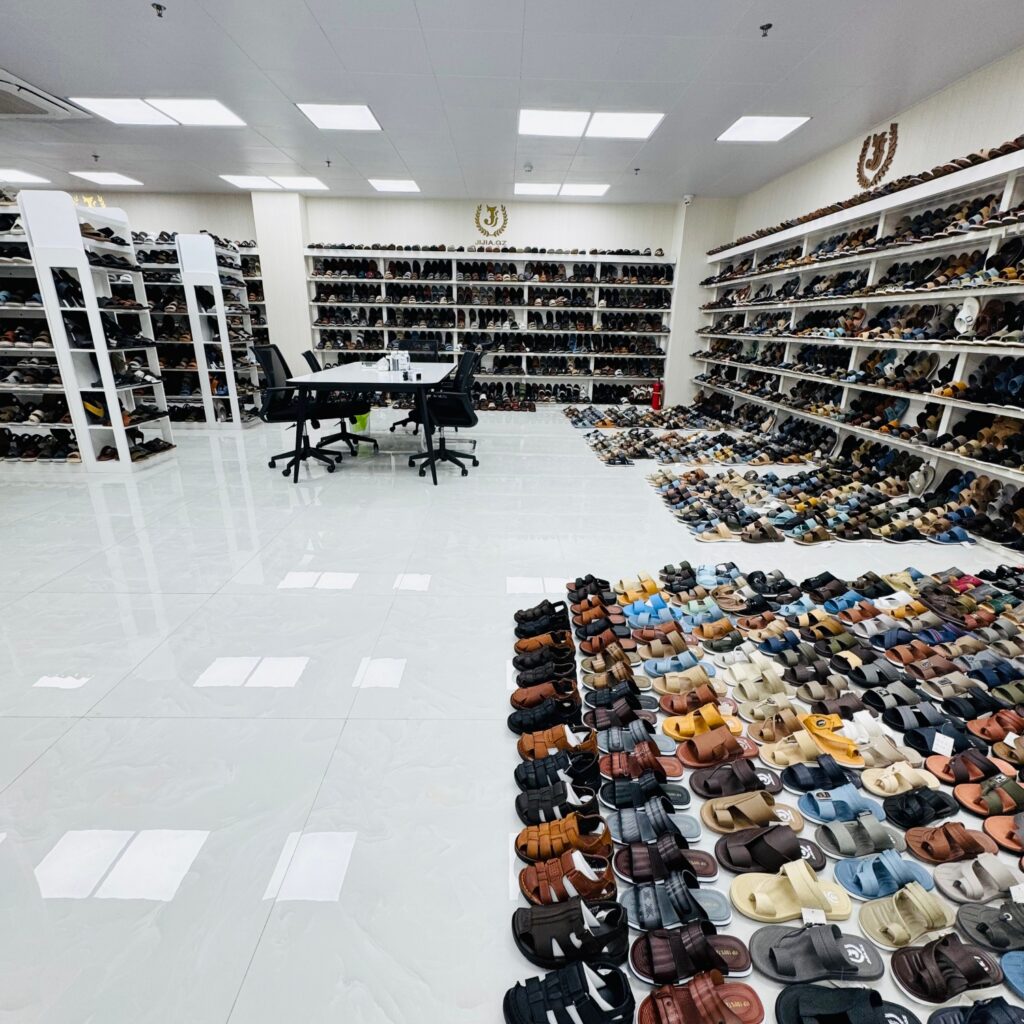
Direct factory MOQ (500–1,500 pairs): Working directly with a factory like JIJIA.GZ gives you transparent pricing, direct technical communication, and the ability to audit production. MOQs are higher than trading companies but prices are lower and quality is more controllable.
What “600 Pairs MOQ” Actually Means
The most common misunderstanding among first-time buyers is what “MOQ 600 pairs” actually requires. The number means 600 pairs of one style in one colorway—not 600 pairs spread across a collection.
If your collection has 3 styles, each in 2 colorways (6 total SKUs), a 600-pair MOQ means 3,600 pairs total—not 600. Similarly, if a style is offered in 4 sizes, the 600 pairs are distributed across those sizes (e.g., 150 pairs per size), not 600 pairs per size.
Key distinctions buyers must understand:
- Per style: Each distinct shoe model (e.g., a specific sneaker silhouette) counts as one style for MOQ purposes.
- Per colorway: Each color combination requires separate material cutting, separate line setup, and separate QC. A style in black and white is two MOQs.
- Size breakdown within MOQ: The MOQ is the total pairs across all sizes for one style/colorway. Factories typically require a minimum per size (often 30–50 pairs per size) to justify grading and cutting efficiency.
- Sandals and slippers are the exception: Simpler construction and shared materials allow lower MOQs. Sandals at 300 pairs per colorway is realistic for most factories.
When a factory quotes “MOQ 500 pairs,” always clarify: per style, per colorway, or per total order. This single question prevents the most common sourcing budget miscalculation.
How to Legitimately Negotiate Lower MOQs
Real factory MOQs are not immovable, but lowering them requires giving something in return. Six strategies that work in 2026:
- Use stock lasts and molds: Factories maintain libraries of existing foot forms and outsole molds. Choosing stock tooling instead of custom tooling reduces the factory’s setup investment, which is the primary reason for MOQ thresholds. This can reduce MOQ by 20–30%.
- Consolidate colorways: Instead of 4 styles × 1 colorway (4 MOQs), produce 2 styles × 2 colorways. Same number of SKUs, but the factory runs longer on each line, improving efficiency and potentially reducing per-style MOQ by 10–15%.
- Specify standard materials: Custom-milled fabrics and proprietary compounds carry their own material MOQs (often 500–1,000 square meters). Using the factory’s stocked materials eliminates these secondary minimums.
- Commit to a program, not a one-off: Factories lower MOQs for buyers who commit to 2–3 production runs over 6–12 months. A signed letter of intent for future orders demonstrates volume commitment and gives the factory confidence to accept a smaller initial run.
- Accept a small-run surcharge: Offer to pay a 10–20% per-unit surcharge for orders below standard MOQ. This compensates the factory for the lower line efficiency and is almost always cheaper than the trading company markup.
- Start with sandals or simple constructions: Sandals, slippers, and simple cemented constructions have lower setup costs than strobel or injection-molded footwear. Beginning your brand with sandal or slipper styles allows entry at 300-pair MOQs while building the supplier relationship for larger future orders.
Red Flags: When Low MOQ Claims Are Too Good to Be True
The footwear sourcing landscape includes operators who exploit startup brands’ desire for low MOQs. Four red flags that indicate a “low MOQ” offer is not what it claims:
- MOQ 50 pairs “fully custom”: True custom manufacturing requires custom lasts, outsole molds, and pattern development—$2,000–$6,000 in tooling alone. At 50 pairs, tooling adds $40–$120 per pair. A factory offering 50-pair custom at $15/pair is almost certainly using stock molds and presenting them as custom, or outsourcing to a print-on-demand service that cannot deliver consistent quality at scale. Neither is true OEM/ODM.
- Pressure for 100% upfront payment: Legitimate factories require 30–50% deposit, with balance due after QC inspection and before shipment. Demands for 100% upfront payment, especially via wire transfer to a personal account, are a strong indicator of fraud or a trading company with no factory relationship.
- No samples provided: A factory that cannot or will not produce a physical sample before bulk production is either not a factory or is planning to deliver a different product than quoted. Always require a pre-production sample (PPS) and approve it in writing before authorizing bulk.
- Unrealistically fast timelines: A factory promising 7-day delivery for a custom shoe from scratch is not building your shoe—it is shipping from existing inventory (likely stock designs sold as “custom”). Real custom production requires 7 days for sampling plus 25–35 days for bulk, minimum.