
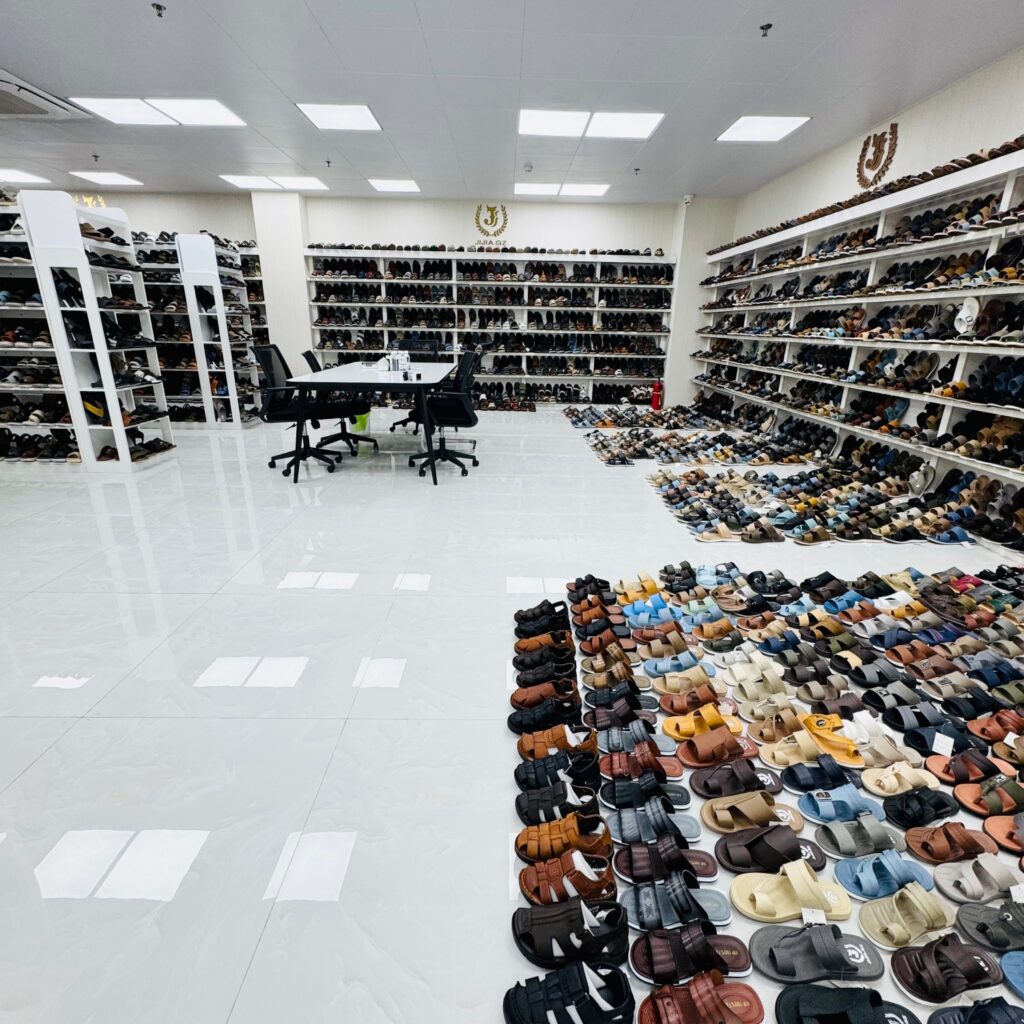
A Premium Market at Full Speed
The Saudi Arabia footwear market 2026 is no longer a niche play. With the premium segment alone valued at more than $1 billion (industry estimates) and year-over-year growth of 8.9%, the Kingdom has cemented itself as the most lucrative footwear destination in the Gulf Cooperation Council (GCC). Vision 2030 reforms, a surging tourism sector, and a young, digitally fluent population are pulling international brands and private-label importers into a market that rewards quality over volume.
For B2B footwear importers, distributors, and brand owners, the opportunity is clear: Saudi buyers are willing to pay a premium average selling price of around $300 per pair in the premium tier, yet domestic production covers only a fraction of demand. The gap is filled by imports, and Chinese manufacturers with the right compliance credentials are increasingly the partners of choice. This guide breaks down the market, the regulations, and the sourcing path.
Market Size and Growth
Saudi Arabia’s footwear market is structured around three demand engines: a fast-growing premium and luxury segment, a mass-market casual and athletic segment, and a culturally rooted traditional footwear segment. The premium tier alone accounts for over a billion dollars, and the broader market continues to expand as per-capita income rises and consumer preferences shift toward branded, status-driven purchases.
| Metric | 2026 Figure | Context |
|---|---|---|
| Premium footwear market value | more than $1 billion (industry estimates) | Up 8.9% year-over-year |
| Average selling price (premium) | around $300 / pair | Among highest in GCC |
| Riyadh e-commerce registrations | thousands of | Dominant distribution hub |
| GCC common external tariff (footwear) | 5% | Uniform across member states |
| Domestic production share | Below 15% | Heavy reliance on imports |
Riyadh remains the undisputed commercial hub, with a large and growing set of registered e-commerce businesses operating in the capital region. This concentration means that a well-connected importer with Riyadh-based distribution can reach the majority of the Kingdom’s online footwear demand through a single logistics base. Jeddah serves as the primary port of entry and a secondary distribution node, while Dammam anchors the Eastern Province and connects to the broader GCC road network.
The growth narrative is also demographic. Over 63% of Saudi Arabia’s population is under the age of 30, and this cohort drives the majority of sneaker, athleisure, and premium casual footwear purchases. Social commerce, Instagram-driven brand discovery, and the proliferation of regional e-commerce platforms have shortened the path from trend awareness to purchase, making the market exceptionally responsive to well-merchandised product lines.
Import Regulations and Compliance
Saudi Arabia has tightened its import compliance framework significantly since 2019, and 2026 is no exception. For footwear importers, the non-negotiable gateway is SABER certification, the electronic platform operated by the Saudi Standards, Metrology and Quality Organization (SASO) that governs conformity assessment for regulated products entering the Kingdom.
SABER: The Two-Certificate System
Footwear importers must obtain two certificates through the SABER platform:
- Product Certificate (PC): Issued for each product model, based on test reports from a SASO-recognized laboratory. The PC confirms that a specific shoe model conforms to the applicable SASO technical regulation, including mechanical safety, chemical limits (such as restricted substances in linings and insoles), and labeling requirements. The PC is valid for one year and must be renewed for continued importation.
- Shipment Certificate (SC): Issued per consignment, the SC is the document that Saudi Customs actually clears against at the port of entry. The SC verifies that the physical shipment matches the approved PC and that the goods conform to the registered specifications. No SC means the shipment will be held or re-exported.
Factory Audits for Newer Suppliers
A critical nuance for importers sourcing from China: factories less than three years old are subject to an on-site factory audit before a PC can be issued under certain footwear categories. This audit covers production capability, quality management systems, and material traceability. For B2B buyers, this means that selecting a manufacturing partner with an established operational history materially reduces compliance cost and lead time. JIJIA.GZ, with over two decades of production history in Guangzhou since 2000, falls well outside this audit trigger, streamlining the certification path for its buyers.
GCC Common External Tariff
Footwear imports into Saudi Arabia fall under the GCC Common External Tariff of 5%, a uniform rate applied across all six member states (Saudi Arabia, the UAE, Kuwait, Bahrain, Qatar, and Oman). Certain essential categories may qualify for exemptions, but the standard duty on most finished footwear is 5% of CIF value. Importers should also budget for VAT, which stands at 15% in Saudi Arabia as of 2026, applied to the duty-paid value.
Labeling and Language Requirements
Footwear sold in Saudi Arabia must carry bilingual labels in Arabic and English. Required information includes the product description, country of origin, size (in EU and Mondopoint where applicable), material composition of the upper, lining, and outsole, and the importer’s details. Non-compliant labeling is a common cause of customs holds, particularly for first-time importers unfamiliar with SASO’s labeling technical regulation.
How to Source Footwear from China
China remains the world’s largest footwear producer and the primary source of imports for the Saudi market. However, the sourcing landscape has evolved. B2B buyers can no longer rely on transactional, market-stall sourcing models if they want to compete in Saudi Arabia’s premium tier. The buyers winning in 2026 are those who structure direct factory partnerships that deliver consistent quality, compliance-ready documentation, and competitive MOQs.
A Practical Sourcing Pathway
- Define your product specification: Start with a clear tech pack, including last shape, material specifications (upper, lining, outsole), sizing run, and target retail price point. The Saudi premium tier rewards genuine leather uppers, comfort footbeds, and clean, minimalist aesthetics.
- Shortlist factories with compliance readiness: Prioritize manufacturers who can produce test reports aligned with SASO technical regulations and who have prior experience shipping to GCC markets. Request sample test reports and prior SABER PC certificates as evidence.
- Request pre-production samples: Never commit to a production run without a golden sample. Evaluate the sample for last fit, material authenticity, construction quality, and labeling accuracy. For premium footwear destined for Saudi Arabia, the sample should be benchmarked against a comparable retail product.
- Negotiate MOQ and replenishment terms: For premium footwear, reasonable MOQs typically range from 500 to 1,500 pairs per model per color. Negotiate production lead times of 30 to 45 days and build a replenishment schedule that accounts for the SABER SC issuance window.
- Structure logistics through a regional hub: Many Saudi importers route shipments through European or UAE distribution hubs, which adds 30 to 60+ days to replenishment cycles. A direct factory-to-Jeddah shipping route can cut this significantly, but requires a factory partner with reliable export documentation.
- Build a quality assurance protocol: Engage a third-party inspection agency (such as SGS, Intertek, or Bureau Veritas) for pre-shipment inspection under AQL 2.5 standards. This is particularly important for the Saudi market, where customs and SABER inspectors are increasingly rigorous on physical conformity.
For a deeper look at OEM and ODM manufacturing options, see our OEM/ODM capabilities page, which outlines minimum order quantities, customization options, and lead times.
Why Partner with a Guangzhou Manufacturer
Guangzhou has been the epicenter of China’s footwear manufacturing industry for over three decades, and the concentration of skilled labor, component suppliers, and logistics infrastructure in the Pearl River Delta is unmatched anywhere else in the world. For Saudi Arabian importers, the advantages of working with a Guangzhou-based manufacturer are tangible and quantifiable.
Established Production History
JIJIA.GZ was established in Guangzhou in 2000, giving the factory continuous production since 2000. This longevity matters for Saudi compliance: as noted, factories less than three years old face mandatory audits under SABER, and buyers sourcing from newer factories frequently encounter delays of 4 to 8 weeks while audits are scheduled and completed. JIJIA.GZ’s history eliminates this friction entirely.
Integrated Supply Chain
The Pearl River Delta offers a vertically integrated footwear supply chain within a 50-kilometer radius. Leather from specialized tanneries, EVA and PU outsole compounds from chemical suppliers, lasts from specialized tooling shops, and packaging from dedicated printing facilities are all available locally. This integration translates into shorter lead times, lower MOQs on custom components, and the flexibility to iterate on samples rapidly, a critical advantage when developing a premium product line for the Saudi market.
Compliance and Documentation
A manufacturer with experience shipping to the GCC will have an established protocol for generating the test reports, declarations of conformity, and shipment documentation that SABER and Saudi Customs require. JIJIA.GZ maintains this documentation framework for its buyers, reducing the compliance burden on the importer and accelerating the PC and SC issuance process. For buyers developing a new private-label brand, the factory also provides product development support ranging from last engineering to material sourcing.
Cost Competitiveness Without Quality Compromise
Direct factory partnerships eliminate the layers of trading-company markups that inflate FOB prices by 15 to 30%. For Saudi importers targeting a premium retail price of around $300 per pair, the margin improvement from sourcing direct is significant. A factory-direct FOB price on a comparable premium leather shoe is typically 40 to 55% below the cost of sourcing the same specification through a European intermediary, even after accounting for freight and duty.