
Why Southeast Asia Matters for Footwear Sourcing in 2026
The Southeast Asia footwear market 2026 represents one of the most dynamic opportunities for B2B shoe buyers worldwide. With a combined population exceeding 680 million, a rising middle class, and accelerating e-commerce penetration, the ASEAN region is no longer just a manufacturing hub—it is a booming consumer market. Southeast Asia’s e-commerce GMV reached $234 billion in 2026.
For B2B footwear importers, distributors, and e-commerce sellers, Southeast Asia offers a rare convergence of competitive manufacturing, favorable trade agreements, and digitally native consumers. China’s footwear exports to Southeast Asia grew 11.3% in 2026, driven by RCEP tariff reductions and social commerce platforms like Shopee, Lazada, and TikTok Shop. Understanding this market is essential for building a profitable supply chain.
Market Overview: Thailand, Vietnam, and Indonesia
Thailand, Vietnam, and Indonesia occupy distinct positions in the regional footwear ecosystem—one as a mature consumer market, one as an export powerhouse, and one as both.
| Country | Market Size / Export Value | Growth Rate | Key Advantage |
|---|---|---|---|
| Thailand | $3.4B domestic market | 3.9% CAGR (2026–2032) | Mature retail, 70% offline channel dominance, women’s segment at 60% |
| Vietnam | $18.3B leather shoe exports (2025) | 4.62% CAGR through 2031 | 40% lower labor costs than China, EVFTA + CPTPP + RCEP access |
| Indonesia | $2.4B footwear export value; market share up to 14.38% | 11.89% YoY export growth (2025) | 3rd-largest global footwear exporter, 370M+ pairs domestic consumption |
Thailand’s $3.4 billion market is projected to grow at a 3.9% CAGR through 2032. Women’s footwear accounts for 60% of sales, while offline retail still commands roughly 70% of the channel mix. For B2B buyers, Thailand represents a stable, brand-conscious market where quality and design differentiation command premium pricing.
Vietnam’s leather shoe exports reached $18.3 billion in 2025, with labor costs approximately 40% lower than China’s. Its free trade agreements—EVFTA, CPTPP, and RCEP—give Vietnamese-produced footwear preferential access to major global markets. Vietnam’s own consumer footwear market is projected to reach $1.39 billion by 2031.
Indonesia ranks among the world’s top three footwear exporters, with export value reaching $2.4 billion and global market share climbing to 14.38%. The country posted 11.89% year-on-year export growth in 2025. Domestic consumption exceeds 370 million pairs annually, making Indonesia both a major production hub and Southeast Asia’s largest footwear consumer market.
Consumer Trends: Asian-Fit Sizing and Social Commerce
Two forces are reshaping the Southeast Asia footwear market 2026: the demand for Asian-fit sizing and the explosive growth of social commerce.
Asian-Fit Sizing Requirements. Southeast Asian consumers have foot anatomies that differ from European or North American populations—wider in the forefoot and toe area, with a relatively narrower heel. Footwear built on standard European lasts often causes discomfort and high return rates. Asian-fit sizing addresses this with wider toe boxes, adjusted girth measurements, and different length-to-width ratios. Japanese sizing expresses foot length in centimeters, Korean sizing multiplies by ten, and Chinese sizing mirrors EU scales but with proprietary width accommodations. For B2B buyers, specifying Asian-fit lasts can reduce return rates by 15–25%.
Social Commerce as the Dominant Channel. Shopee holds approximately 53% of the region’s platform e-commerce GMV ($127 billion in 2025), while TikTok Shop’s GMV doubled to $45.6 billion with 40–55% year-over-year growth. In Vietnam, TikTok Shop overtook Lazada with a 44% market share. Products that succeed on these platforms feature lightweight construction, visually distinctive design, and competitive pricing below 1.5 million rupiah (Indonesia) or 1,000 baht (Thailand). Chinese manufacturers partnering with local livestream agencies are seeing fivefold year-on-year sales growth.
Closed-Toe Comfort and Sustainable Materials. The closed-toe comfort trend is gaining traction across urban Southeast Asia, driven by workplace dress codes and motorbike commuting culture. Lightweight sneakers, casual slip-ons, and hybrid sandal-sneaker designs are outselling traditional flip-flops in Jakarta, Bangkok, and Ho Chi Minh City. Sustainable materials are also becoming a differentiator: recycled insoles certified by the Global Recycling Standard (GRS), bio-based foams, and degradable polyurethane are increasingly requested by brands targeting Gen Z. B2B buyers sourcing footwear with documented sustainable certifications can command 8–15% price premiums.
ASEAN Trade Agreements and RCEP Impact
The ASEAN Free Trade Area (AFTA) and RCEP form the backbone of tariff reduction in the Southeast Asia footwear market 2026. Under the ASEAN Economic Community (AEC), intra-ASEAN tariffs on most footwear categories are 0%, meaning shoes manufactured in Vietnam and sold in Thailand, Malaysia, or Singapore move duty-free within the bloc.
RCEP, in force since January 2022 and encompassing ASEAN plus China, Japan, South Korea, Australia, and New Zealand, commits members to eliminating tariffs on over 90% of traded goods. For footwear, this means Chinese-origin shoes entering ASEAN markets face progressively lower duties—rates previously at 5% or more are reducing toward zero. The landed cost advantage from tariff reduction can be 3–7% of wholesale price, a meaningful margin in a price-sensitive region.
For B2B importers, the takeaway is clear: sourcing from a Chinese manufacturer with an RCEP-compliant Certificate of Origin enables tariff-preferential access to all ASEAN markets. Buyers should confirm their manufacturer can issue RCEP origin certificates before placing orders.
How Chinese Manufacturers Serve Southeast Asian Buyers
Chinese footwear manufacturers serve as both direct suppliers to Southeast Asian distributors and production partners for regional brands. Guangzhou has become the sourcing hub of choice for ASEAN buyers due to its mature supply chain and concentration of OEM/ODM factories.
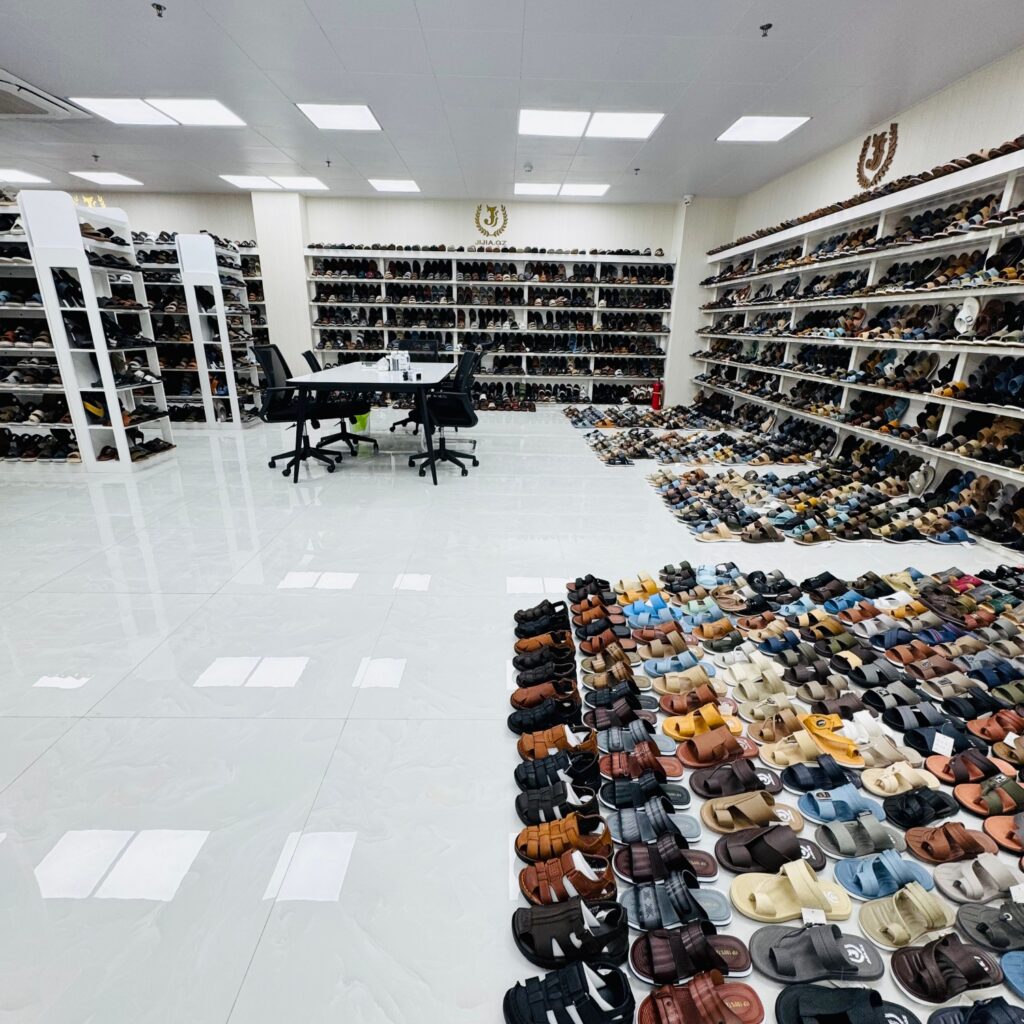
JIJIA.GZ, based in Guangzhou since 2000, exemplifies this model. With MOQ of 500 pairs per style (300 for sandals), a 7-day sampling cycle, and 25–35 day production lead times, the factory is structured for the flexibility that Southeast Asian distributors and e-commerce sellers require. The product range spans lightweight sneakers, casual shoes, sandals, and comfort footwear—categories that align directly with Southeast Asian consumer preferences. The factory’s Asian-fit sizing expertise means buyers can specify wider toe boxes and region-appropriate size charts without costly retooling.
For e-commerce sellers, key advantages include rapid trend replication for Shopee and TikTok Shop cycles, customizable private-label packaging, and platform-ready product photography. Buyers can explore OEM/ODM capabilities or request a quote. FOB, CIF, and EXW terms are available.
China’s 11.3% export growth to Southeast Asia in 2026 reflects a structural shift: as Western markets face tariff uncertainty, Chinese manufacturers are orienting capacity toward ASEAN buyers, investing in Asian-fit last development and regional e-commerce partnerships. For B2B footwear buyers, this means better service and more competitive pricing than at any point in the past decade.