Why Verification Is the Most Important Step in Footwear Sourcing
A proper verify Chinese shoe factory audit is the single most effective safeguard a B2B buyer can perform before committing capital. China produces over 13 billion pairs of footwear annually, and while the country hosts thousands of legitimate manufacturers, the supplier directories of Alibaba, Made-in-China, and Global Sources are saturated with intermediaries presenting themselves as factories. Up to 80% of inquiries labeled “factory” actually originate from trading companies with no production line of their own. A structured verification process—covering business licenses, third-party audits, on-site inspections, and behavioral red flags—separates genuine manufacturers from agents, protects deposits, and prevents the quality and lead-time failures that destroy product launches.
The 80% Problem: Trading Companies Masquerading as Factories
In 2026, the gap between a listed “factory” and a real factory has widened. B2B marketplace data shows that roughly 80% of supplier accounts that self-identify as manufacturers are in fact trading companies, sourcing agents, or shell entities. These intermediaries occupy no production floor, employ no line workers, and exercise no control over quality or lead time. They exist to capture margin between the buyer and an undisclosed workshop, often marking up FOB prices by 15–30% while offering no added engineering value.
The risk is not only cost inflation. When a quality defect surfaces mid-production, the trading company cannot fix it—they must negotiate with the real workshop on the buyer’s behalf, adding weeks to lead times and diluting accountability. For B2B footwear buyers managing private-label launches or retail replenishment calendars, this opacity is the root cause of missed seasons, rejected shipments, and lost margin. Verification is the only reliable countermeasure.
Recognizing the pattern is the first step. Trading companies typically exhibit a broad product catalog spanning unrelated categories (shoes one page, electronics the next), a registered business scope limited to “trading” rather than “manufacturing,” and an inability to produce real-time production line photos or video. A genuine factory, by contrast, can describe its equipment, worker count, daily output, and last inventory in specific terms.
Audit Types: Cost and Coverage Comparison
Buyers have three tiers of verification available, each with a different cost, depth, and evidentiary weight. The right choice depends on order size, risk tolerance, and whether the buyer’s downstream market (EU, US, GCC) imposes social compliance requirements.
| Audit Type | Typical Cost (2026) | What It Covers | Turnaround |
|---|---|---|---|
| In-person third-party audit SGS, Bureau Veritas, TÜV SÜD, Intertek, QIMA |
$2,000–$4,000 | On-site factory tour, capacity verification, equipment checklist, worker interviews, social compliance (BSCI/SMETA), document review | 5–10 working days |
| Regional QC firm audit Shenzhen/Guangzhou-based inspection companies |
$1,000–$2,000 (30–50% cheaper) |
Physical address confirmation, production line photos, capacity check, document verification; lighter social compliance coverage | 3–7 working days |
| Document-based verification Desktop review |
$300–$800 | Business license, export license, certifications, and referenced factory photos reviewed remotely without on-site visit | 2–5 working days |
For orders under 2,000 pairs, a document-based verification combined with a pre-shipment inspection is often sufficient. For orders exceeding 10,000 pairs or for buyers entering a multi-year supply relationship, an in-person third-party audit from a recognized firm is the standard of care—and increasingly a requirement of EU and US retail buyers who mandate BSCI or SMETA social compliance before placing an order.
Essential Documents: What a Real Factory Must Provide
A legitimate Chinese footwear manufacturer should be able to produce, without hesitation, a defined set of documents. Hesitation, delay, or refusal on any of these is itself a red flag.
- Business License (营业执照): The foundational document. Issued by the local Administration for Market Regulation, it lists the registered company name, legal representative, registered capital, founding year, and—critically—the business scope. A real manufacturer’s scope will include “manufacturing” or “生产” (e.g., 鞋类生产). A trading company’s scope will read “trading” or “销售” (e.g., 鞋类销售). This single field exposes the majority of misrepresentations.
- Export License / Foreign Trade Registration: Confirms the entity is authorized to export directly. Without it, the company must route exports through a third-party trading agent—another sign of a non-factory.
- BSCI or SMETA Audit Report: Social compliance audits valid for 24 months. BSCI (Business Social Compliance Initiative) and SMETA (Sedex Members Ethical Trade Audit) are the two most widely accepted frameworks. EU retail buyers and several US brands require a current BSCI or SMETA report before onboarding a supplier. Verify the audit is within its validity window and that the audited facility address matches the supplier’s stated factory address.
- WRAP Certification: Worldwide Responsible Accredited Production certification confirms social compliance across labor, environmental, and safety standards. It is particularly relevant for buyers sourcing for US retailers and is renewed annually.
- Product Liability Insurance: A certificate of insurance covering product liability, typically with coverage limits of $500,000–$2,000,000. This signals that the factory stands behind its output and has the financial backing to support claims.
- Factory Photos with Verifiable Context: Not stock images. Request photos showing the company name on the building facade, dated production lines with the current date visible, and equipment nameplates. Reverse-image search any photo; if it appears on multiple supplier listings, it is not a real factory photo.
Red Flags: Warning Signs When Vetting a Supplier
Certain behavioral and structural signals reliably indicate that a “factory” is not what it claims. Encountering even one of these warrants deeper diligence; encountering two or more should end the conversation.
- Pressure for 70–100% upfront payment: Legitimate manufacturers typically request a 30% deposit with the balance due against a bill of lading or after pre-shipment inspection. Demands for 70–100% prepayment before production indicate either a cash-flow-starved workshop or an intermediary with no intent to deliver.
- Reluctance or refusal to provide samples: A real factory can produce a pre-production sample within 7–14 days. A trading company must first source the sample from an undisclosed workshop, and may resist sampling because it exposes the markup or reveals their lack of production control.
- No independent web presence beyond marketplace listings: A genuine manufacturer typically maintains a standalone website (often bilingual), a verified company page, and traceable contact details. If the only footprint is a marketplace storefront created in the last 12–24 months, proceed with caution.
- No verifiable physical address: Cross-check the factory address on Google Maps and Google Street View. A real factory occupies a recognizable industrial building. If Street View shows a residential apartment block, a virtual office, or an empty lot, the entity is not manufacturing shoes there.
- Unusually broad product catalog: Factories specialize. A supplier offering men’s leather shoes, women’s heels, sports sneakers, children’s boots, and rubber sandals simultaneously is almost certainly a trading company aggregating multiple workshops.
- Inability to answer technical questions: Ask about last shapes, stitching density (stitches per inch), outsole compound (EVA vs. PU vs. rubber), or the bonding process (cemented, vulcanized, strobel). A factory’s sales engineer answers in specifics; an agent deflects to “we can do whatever you need.”
The Verification Checklist: What to Confirm Before Committing
Before transferring a deposit, a B2B buyer should be able to confirm each of the following. This checklist represents the minimum evidentiary threshold for a credible sourcing decision.
- Factory address verified on Google Maps / Street View: Confirm the address resolves to an industrial building, not a residential or virtual office. Cross-reference the address on the business license with the address stated in the supplier profile.
- Production line photos or video: Request dated photos or a live video call walking the production floor. Look for lasted shoes on the line, cutting tables in use, and the company name visible on signage.
- Worker count: A credible footwear factory employs between 80 and 500 line workers depending on category. Fewer than 50 workers suggests a workshop incapable of scaling; claims of 1,000+ without supporting evidence suggest exaggeration.
- Annual production capacity: A reasonable benchmark for a mid-sized Chinese footwear factory is 500,000+ pairs per year. Factories below this threshold may lack the scale for large B2B orders or consistent quality systems.
- Defect rate: Ask for the factory’s internal defect rate. A well-run factory reports 0.8–1.2%; the industry average sits at 2–4%. A factory that claims “zero defects” is either untruthful or not measuring—a red flag in itself.
- Certifications within validity: BSCI/SMETA (24-month validity), WRAP (annual renewal), and any product-specific test reports (REACH, CPSIA, SASO) should be current and traceable.
- References from prior B2B buyers: A factory with export history should be able to reference prior shipments to comparable markets. Redacted buyer names are acceptable; the ability to describe shipment volume and destination markets is not.
For buyers unfamiliar with Chinese-language document verification, engaging a regional QC firm for a document-based check ($300–$800) before a site visit is a cost-effective first filter. Learn more about our company background and history to see how an established manufacturer presents this evidence.
How JIJIA.GZ Passes Verification
JIJIA.GZ (Guangzhou Jijia Shoes and Apparel Trading Co., Ltd.) was established in Guangzhou in 2000 and has maintained continuous footwear production for over 25 years. The factory’s verification profile is transparent at every checkpoint in the checklist above.
- Business license: Registered in Guangzhou, Baiyun District, with a manufacturing-aligned business scope. Available on request and verifiable through the National Enterprise Credit Information Publicity System.
- BSCI audit: Current social compliance audit conducted by an accredited body, valid within the 24-month window. Available for buyer review.
- In-house QC team: A dedicated quality control team operates a four-stage process covering material inspection, stitching, assembly, and packaging—detailed in our OEM/ODM capabilities page. Internal defect rates fall within the 0.8–1.2% band, well below the 2–4% industry average.
- Factory visits welcome: Buyers and their appointed third-party auditors are invited on-site. The factory can arrange live video walkthroughs for buyers unable to travel, and third-party audits from SGS, Bureau Veritas, Intertek, or QIMA are accepted on standard terms.
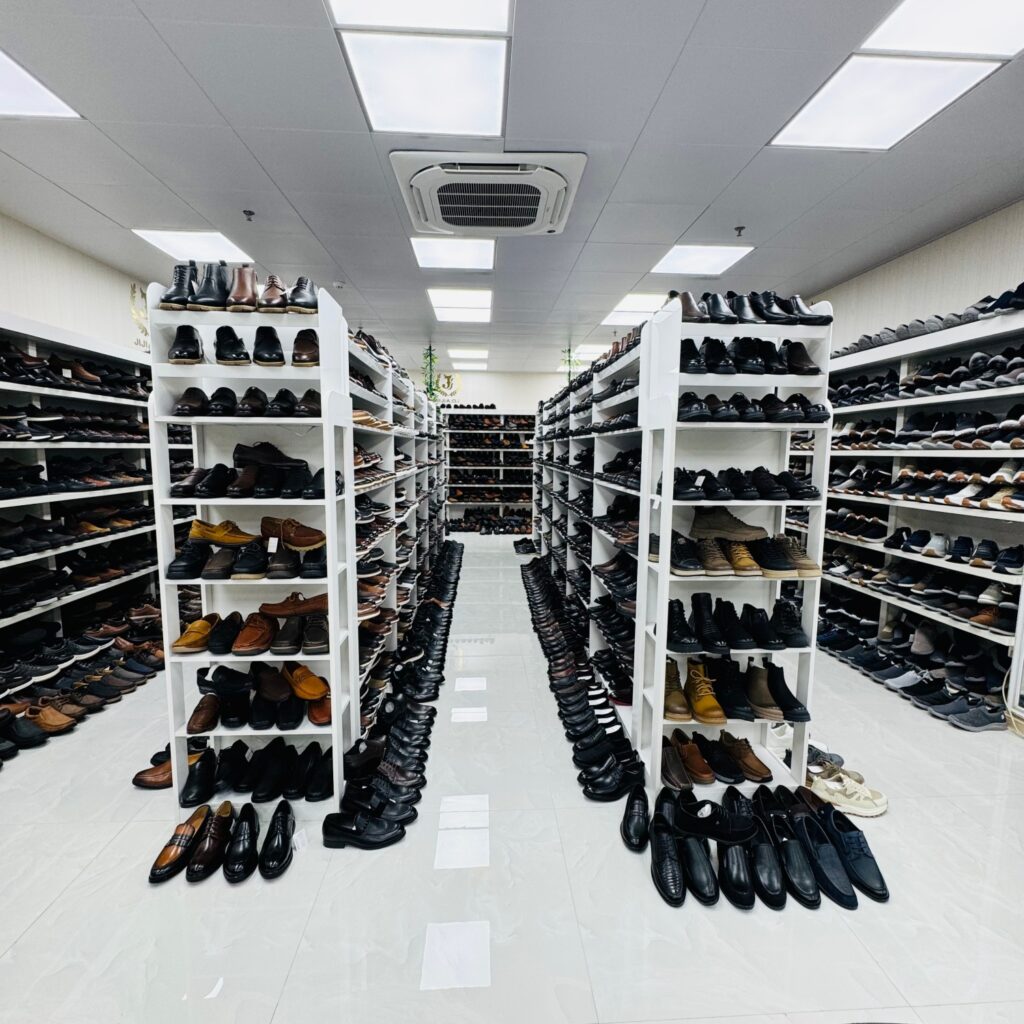
- Verifiable address and capacity: Located at an industrial address in Guangzhou’s Baiyun District, with production capacity exceeding 500,000 pairs annually across OEM and ODM orders.
This transparency is not a marketing posture—it is the operational baseline that allows JIJIA.GZ to ship to Middle Eastern, African, Russian, Central Asian, and Southeast Asian markets with the documentation each requires. Buyers are encouraged to contact the team to request business license copies, BSCI reports, and capacity declarations before placing an order.