
Why Footwear Quality Control Determines Whether Your Order Ships
Footwear quality control China is the difference between a shipment that clears customs, retails at full margin, and builds a brand—and a container that is rejected, discounted, or returned. The AQL 2.5 standard governs acceptable quality levels in footwear inspection, classifying defects as critical, major, or minor, and defining the sampling size and pass/fail threshold for every production batch. For B2B buyers, understanding these checkpoints, common failure points, and how to specify QC requirements in a contract is the single most effective lever for protecting product quality and margin. Shoes that look perfect in a static photo routinely fail when flexed, measured, packed, or worn—only a structured, multi-stage inspection process catches these defects before they reach the customer.
The AQL 2.5 Standard: How Footwear Defects Are Classified
The Acceptable Quality Limit (AQL) standard, codified in ISO 2859-1 and widely adopted in footwear manufacturing, defines the maximum number of defects permissible in a random sample before a batch is rejected. AQL 2.5 is the footwear industry default, meaning a batch is acceptable only if the number of defects in the sample does not exceed the defined acceptance number for that sample size.
| Defect Class | Definition | Examples in Footwear | AQL Acceptance |
|---|---|---|---|
| Class A — Critical / Serious | Defects that could cause injury, violate regulatory standards, or render the product unsellable | Sharp metal fragments in footbed; banned restricted substances (e.g., lead above CPSIA limit); wrong size label; mismatched pairs in a box | AQL 0.0 (zero tolerance) |
| Class B — Major | Defects that materially affect function, durability, or appearance and would cause a consumer to return the product | Sole separating from upper; skipped stitches on a load-bearing seam; visible wrinkles on lasted upper; strong chemical odor | AQL 2.5 |
| Class C — Minor | Defects that are cosmetic and do not affect function or fit, but reduce perceived quality | Stray glue marks on upper; minor color variation between pair mates; loose thread ends; slight box creasing | AQL 4.0 |
Under AQL 2.5, a sample of 200 pairs from a 10,000-pair lot permits a maximum of 10 major defects (acceptance number = 10) before the entire batch is rejected. Critical defects are zero-tolerance: a single Class A finding triggers automatic rejection regardless of sample size. This framework gives B2B buyers a defensible, quantitative standard—replacing subjective “looks fine” approvals with a pass/fail protocol recognized by SGS, Intertek, Bureau Veritas, and QIMA inspectors worldwide.
Key QC Checkpoints in Production Order
Effective footwear quality control in China is not a single end-of-line inspection. It is a sequence of eight checkpoints that track the shoe from raw material to boxed product. Each checkpoint catches a distinct class of defect, and skipping any one allows failures to compound downstream—where they become exponentially more expensive to fix.
- Material inspection (upper, lining, outsole, accessories): Before cutting begins, inspectors verify that incoming materials match the approved specification. Checks include color consistency across dye lots, material thickness (measured with a digital thickness gauge), texture and grain uniformity, and stretch test for leather and synthetic uppers. A material that drifts from spec here cannot be corrected later—rejecting it at intake is the only economical fix.
- Cutting stage: Verify pattern accuracy against the approved tech pack, confirm that cut panels are free of defects (marks, holes, thin spots), and check that directional materials like nubuck or suede are cut in the correct orientation. Cutting is where grain mismatch and asymmetric panels originate—both of which become visible, unfixable defects after assembly.
- Stitching and upper assembly: Inspect seam strength (pull test), stitch density (stitches per inch against spec), and confirm no skipped stitches, broken thread, or needle damage. The upper is the structural backbone of the shoe; stitching defects here cause seam failure in wear within weeks.
- Lasting and molding: Verify the lasted shape matches the approved last, confirm left-right symmetry within a pair, and check for wrinkles, folds, or tension lines in the upper material. Lasting defects produce shoes that look misshapen on the shelf and fit incorrectly on the foot.
- Outsole bonding: Perform a pull test (often using a spring-loaded or pneumatic pull tester) to verify bond strength between the outsole and upper. Check for gaps, air bubbles, or incomplete cement coverage at the bonding line. Sole separation is the most common major defect in footwear returns—this checkpoint is its primary defense.
- Insole and accessories: Confirm correct insole placement, verify size label accuracy (a wrong size label is a Class A critical defect), and check that accessories (eyelets, laces, buckles) are correctly positioned and functional. Insole length measurement errors cause mismatched fit even when the shoe is otherwise perfect.
- Finishing: Inspect for cleanliness—no glue marks on the upper, no stray thread, no ink or handling marks. Verify no chemical odor (a strong solvent smell indicates incomplete curing or restricted substance residues). Finishing is where minor Class C defects are caught and corrected before they reach the box.
- Packaging: Confirm correct size and quantity per carton, verify box labels match the contents, check that size stickers and barcodes are accurate and scannable, and confirm carton markings match the packing list. Packaging errors cause customs holds, retail mis-ships, and marketplace listing suspensions.
For a factory to run all eight checkpoints requires a dedicated QC team with authority to halt the line. This is the structural difference between a manufacturer and a workshop. See how a structured OEM/ODM process embeds QC at each stage.
Common Failure Points: Where Shoes Actually Break
Across thousands of footwear inspections, a consistent set of failure modes accounts for the majority of rejected units. B2B buyers who know these failure points can specify targeted inspections that catch defects before shipment rather than after retail delivery.
- Sole separating from upper (weak adhesive): The most common major defect. Caused by inadequate surface preparation, insufficient cement coverage, incorrect curing temperature, or incompatibility between cement and outsole compound. Caught only at the outsole bonding pull test—not visible to the eye.
- Wrong insole length measurement: A frequent critical defect. If the insole is cut 3–5mm short, the shoe fits small; if long, the footbed buckles. Insole length must be verified against the size chart at the insole and accessories checkpoint, not assumed.
- Mismatched pairs: Left and right shoes of different sizes, colors, or materials packed together. Caused by line mixing during last changes or size runs. A Class A critical defect under AQL 2.5—zero tolerance. Pair matching must be verified at finishing and again at packaging.
- Poor material consistency: Color variation between pair mates, thickness variation that affects fit, or texture drift between dye lots. Originates at material intake and compounds through every downstream stage. The only fix is rejection at the source.
- Odor issues: A strong chemical or solvent smell indicates incomplete curing, restricted substance residues, or inappropriate adhesive selection. Odor defects trigger EU REACH non-compliance findings and retail returns. Caught only by olfactory inspection at finishing—no instrument substitutes for a trained nose.
- Metal fragments or sharp edges: Broken needles, staples, or metal shavings embedded in the footbed or upper. A Class A critical defect with zero tolerance under AQL 2.5. Detected by metal detection at finishing or by hand probing; missing a needle fragment creates an injury liability that dwarfs the cost of the shoe.
Dynamic Inspection: Why Static Photos Are Not Enough
The defining insight of footwear quality control China is that shoes look fine in a static photo but fail when flexed, measured, packed, or worn. A photo of a shoe on a white background cannot reveal sole bonding strength, insole length accuracy, stitch density, or chemical odor. Yet many B2B buyers approve production based on supplier-provided photos alone—a practice that virtually guarantees that major defects reach the customer.
Dynamic inspection means testing the shoe under the conditions it will encounter in use. A flex test bends the forefoot 30,000 times to simulate walking—catching sole bonding and lasting defects that no photograph can show. A pull test quantifies bond strength in newtons. A pair-match measurement compares left and right shoes against each other and against the size spec. An odor assessment is conducted by trained inspectors in a controlled environment. These tests require instrumentation and protocol, not a camera.
For B2B buyers, the implication is concrete: require inspection reports that include test data—pull test values, flex test pass/fail, insole length measurements, metal detection results—not just photographs. A credible QC report is a document of measurements; a photo album is marketing.
Specifying QC Requirements in Your Contract
Quality control is only enforceable if it is written into the manufacturing contract. A verbal agreement to “check quality” is unenforceable; a contract clause specifying AQL level, inspection timing, and third-party inspection rights is a commercial commitment the factory must honor. B2B buyers should include the following in every purchase order or manufacturing agreement.
- AQL level: Specify AQL 2.5 for major defects and AQL 0.0 for critical defects. State the sampling plan (e.g., ISO 2859-1, general inspection level II). This defines exactly how many pairs are inspected and what defect count triggers a rejection.
- Inspection timing: Contract three inspection windows. Pre-production inspection verifies materials and the first off-tool samples before bulk cutting. During-production inspection (DUPRO) checks the first 10–20% of completed output to catch systematic defects early. Pre-shipment inspection (PSI) is the final AQL sampling before container loading—the gate that releases payment.
- Third-party inspection rights: Reserve the right to engage SGS, Intertek, Bureau Veritas, or QIMA for any or all of the three inspections, at the buyer’s discretion. The contract should state that the factory will grant access, provide a sampling area, and release the inspection report before shipment.
- Defect liability: Define remedies for rejected batches: rework at the factory’s cost, replacement units, or order cancellation with deposit refund. State that final payment is released only after a passing pre-shipment inspection report.
- Golden sample retention: Require both parties to sign and retain a sealed golden sample. Production must match the golden sample in materials, construction, and dimensions. Deviation from the golden sample is a contract breach.
For a template of QC clauses and inspection scheduling, visit our FAQ page or contact our team for a sample manufacturing agreement.
JIJIA.GZ In-House QC: The Four-Stage Process
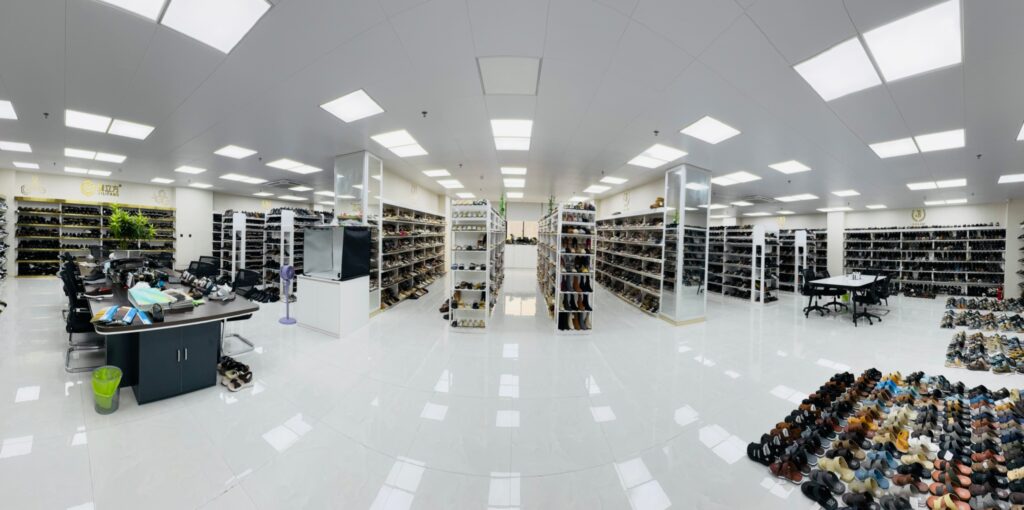
JIJIA.GZ operates an in-house quality control team independent of the production line, with authority to halt production at any stage. The factory’s QC process is structured across four stages that map to the eight checkpoints above, compressed for operational clarity.
- Stage 1 — Material inspection: Incoming upper, lining, outsole, and accessory materials are checked against the approved spec for color, thickness, texture, and stretch. Materials failing intake are rejected before they reach cutting—preventing downstream compounding.
- Stage 2 — Stitching inspection: Upper assembly is inspected for seam strength, stitch density, skipped stitches, and upper symmetry. This stage catches the structural defects that cause field returns within weeks of wear.
- Stage 3 — Assembly inspection: Lasted shape, outsole bonding (pull test), insole placement, and size label accuracy are verified. Pair matching is confirmed at this stage—left and right shoes are measured against each other before they proceed to finishing.
- Stage 4 — Packaging inspection: Finished shoes are inspected for cleanliness, odor, and accessory function, then verified for correct size, quantity, and label accuracy at the carton level. AQL 2.5 sampling is applied to the final batch before container release.
The factory’s internal defect rate sits within 0.8–1.2%, compared with the footwear industry average of 2–4%. This is the measurable outcome of running all four stages with authority to stop the line—a structure that a trading company, which controls no production floor, cannot replicate. Third-party inspections from SGS, Bureau Veritas, Intertek, or QIMA are welcomed and scheduled on standard terms. Buyers can review the full OEM/ODM process or request a QC protocol for their order.